SEO keyword research: the seven questions people actually ask
SEO keyword research is the process of finding the words and phrases people type into search, then deciding which ones are worth writing for. The decision is not just about how often a term is searched. It is about whether you can rank for it, whether the searcher wants what your page offers, and whether the interest is rising or fading. Everything below answers a specific question using measured data rather than general advice.
The seven questions are taken from Google's own related-query data for this topic, not invented for this page. Every number quoted is reproducible from the linked datasets.

1. What is SEO keyword research?
It has two halves. Discovery finds candidate phrases — from search suggestions, related queries, your own search console, or a keyword tool. Selection decides which candidates deserve a page, by checking the competing results, the search intent, and the direction of interest over time. Skipping the second half is why many sites publish dozens of pages that never rank.
In Google's related-query data for this exact topic, the closest phrasings people use are keyword research for seo (relative interest 100), seo and keyword research (75), and keyword research in seo (71). Those are the same question expressed three ways.
2. What is keyword research in SEO?
Same activity, different word order. The useful distinction is not the wording but the output: a shortlist of terms with a reason for each. A defensible shortlist records where the term came from, what the current results look like, and what evidence exists that interest is stable, seasonal, or growing.
3. How do you do SEO keyword research?
Start from terms you already know describe your topic, expand them into longer variations, check each against the actual results page, then confirm the interest trend before committing. A measured example: the US term keyword trends over a 12-month window returned 53 weekly readings. The series peaked at index 100 on 18 January 2026, fell to 0 on 30 August 2026, and ended at 8 in a final week Google marks incomplete. A six-month-old snapshot of that term would have told a completely different story than the current one.
The full explainer publishes all 53 weeks as a downloadable table, along with the arithmetic for converting an index reading into a share of the peak week.
4. How do you do keyword research for SEO?
The practical difference from question 3 is sequencing. One approach builds a shortlist first and validates each term against trend data later. The other starts from related searches and treats the trend tool as a final check. Neither is universally right. What matters is that the trend reading is attached to one query, one geography, and one date range — because the index rebuilds its own 100 for every window.
5. What are the best tools for SEO keyword research?
Tools fall into three groups: Google's own free surfaces, third-party keyword databases, and your own search console. Google's related-query and trend data is free and reproducible; it tells you relative interest and phrasing, not absolute volume.paid databases add volume and difficulty estimates. Search console tells you what already brings impressions to your pages. A workflow that uses only one of the three will have a blind spot.
If you automate the Google side, expect version-sensitive failures. On pytrends 4.9.2 with urllib3 2.8.0, passing a retries argument raises a TypeError before any request is sent, and two rapid calls in one session return 429 Too Many Requests on the second. The tested error breakdown gives the exact tracebacks and the configuration that worked.
6. How do you use Google Trends for keyword research?
Use it to compare relative interest across terms, spot seasonal peaks, and read related queries — not to extract a monthly search count. The 0–100 scale is a share of the busiest week in your chosen window. A reading of 20 means that week carried 20 percent of the traffic of the peak week; it does not mean 20 searches. Across the 53-week series cited above, the mean was 41.26, the first four weeks averaged 31.75, and the last four averaged 11.50 — a decline expressed on one fixed scale.
7. What is keyword research?
At its simplest: the work of matching the words people search to the pages you create. Done well it is a record of evidence, not a list of guesses. Done badly it is a spreadsheet of numbers with no source and no date. If you take one habit from this page, make it this: write down where each number came from and when you pulled it.
Which question is rising fastest
Of all the related queries measured for this topic in the US over the last 12 months, seo keyword research report was the only one flagged as rising, at over 180 percent. That is a phrasing about output — people want to see what a finished research report looks like, not just a method. Expect more pages in this space to publish real, dated datasets rather than abstract steps.
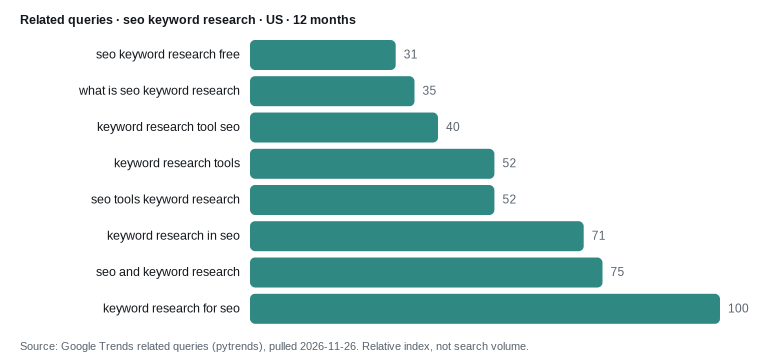
| Question | Google related query | Relative interest |
|---|---|---|
| What is it | what is seo keyword research | 35 |
| What is it (variant) | what is keyword research in seo | 21 |
| How to do it | how to do seo keyword research | 16 |
| How to do it (variant) | how to do keyword research for seo | 10 |
| Best tools | best tools for seo keyword research | 14 |
| Report (rising) | seo keyword research report | 14 · RISING 180%+ |
Source: pytrends related_queries, geo=US, timeframe=today 12-m, pulled 2026-11-26. Values are relative search interest from Google, not search volumes and not estimates.